


Introduction
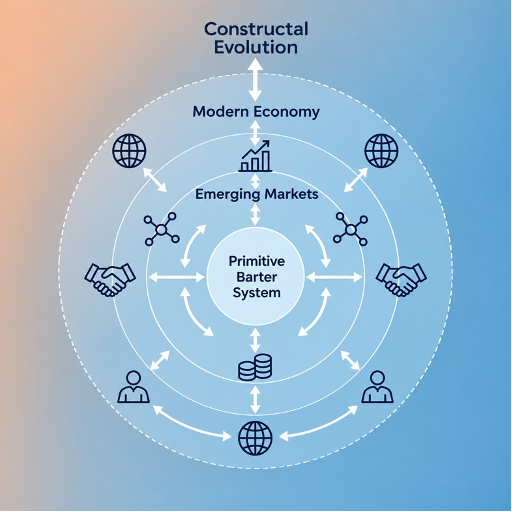
The Constructal Law has a broad purview of applicability, spanning mechanical engineering[1], physics[2], thermodynamics[3], biology[4], and even geography[5]. We believe that a school of thought centered on integrating the Constructal Law with economics and finance would serve as a nexus for further research, and as such, we are presenting here an outline for its development.
A recurring theme in the history of macroeconomic thought is that economic systems are flow systems. Capital flows toward return. Risk flows to where it is least priced. Information flows until it is arbitraged away. Notably, Irving Fisher in 1891 and Bill Phillips in 1949 went so far as to build water-based hydraulic computers to use as economic models. However, because the Constructal Law was not identified until 1996 and evolutionary economics has long-been at the fringe of mainstream economics, Constructal Theory is still nascently diffusing into economics and finance. Accordingly, we are aiming to shape a new school of economic thought in Constructal finance. Through this lens, the emergence of new financial institutions, such as exchanges, clearing houses, and central banks, can be thought of as economic evolutionary adaptations that reduce financial frictions and make flow more sustainable.
Much as financial panics have been occurring with a roughly decadal historic regularity, identifying their causes and devising mitigative policies remain contentious subjects in the fields of economic history and macroeconomics, especially when the nature of crashes evolves. For example, while the Panic of 1893 serves as one of many datapoints about the timelessness of financial contagions and cascade effects, that economic systems today could again be destabilized by a run on treasury gold reserves is implausible given that we have long departed from the gold standard. Likewise, because the 2008 financial crisis illuminated the vicious dangers of banks overleveraging while systemically underestimating asset risk, in its wake, the Basel III framework was developed.
In accordance with the Constructal Law, for an economic system to persist in time, it must evolve with freedom in such a way to increase the accessibility of monetary flows to the highest available risk-adjusted rate of return. When monetary flows are congested and the system is too constrained to reconfigure itself, financial crises can arise. Importantly, because financial frictions inhibit monetary flow, they are the underlying drivers of the evolutionary reconfiguration process. The history of monetary inventions can largely be understood through this lens: money itself was invented to circumvent the severe coincidence-of-wants friction of bartering, the replacement of the Bretton Woods system with floating exchange rates and fiat currency reduced frictions on government deficit spending, and more recently, the Covid-19 pandemic served as an inflection point for people to increasingly opt for contactless forms of payment as fumbling with cash became a transactional friction. Modelling financial frictions is key to stress testing economic systems. However, the complex adaptive nature of economies usually makes predicting their failures with any actionable precision a fool’s errand. Nevertheless, using Constructal Theory, we may be able to at least identify monetary flow chokepoints that will become a catalyst for system reconfigurations and characterize such processes.
Economic and Financial Flows
To rigorously apply the Constructal Law to a flow system, there are at least three key elements that need to be considered: 1) the material or essence of the flow, 2) the boundaries of the system, and 3) the degrees of freedom through which the system can evolve. Perhaps the most obvious type of flow in economics and finance is the flow of money, though information, trade, labor, capital, and risk are also often thought of as economic and financial flows. The boundaries of economic and financial flow systems can be physical, such as a nation’s borders, or nontangible, such as regulations imposed on banks to limit their leverage. Economies are complex adaptive systems, and so they usually contain numerous simultaneous flows and layers of boundaries that generate chaotic noise and feedback. The Constructal Law is most illustrative for evaluating tradeoffs between two or three degrees of freedom; each additional degree of freedom included makes analysis dimensionally more complicated. Good Constructal analysis, thus, requires both engineering and artistic judgment: “The drawing is the permanent record of the fleeting mental viewing. This is why…art and science are one.”[6]
Evolution’s Sidelined Role in Economics
Economics is rife with different schools of thought. Some are major paradigms, both mainstream and broad in scope (e.g. New Neoclassical synthesis), while others more like specialized lenses polished to look at economic phenomena in a stylized way (e.g. Thermoeconomics). One (and perhaps the only) thing common to all schools of thought is that they were founded to give people new ways of thinking about phenomena.
The quantitative toolkit of economics has its roots predominantly in classical physics and engineering; however, economies function less like predictable, tamable machines and more like adaptive, evolving organisms. Evolutionary economics is a school of thought directed toward formulating economics through this latter analogy. Because biology and evolutionary theory offer a less sophisticated mathematical framework than physics and engineering, evolutionary economics has always been marginal, even if it curries significant sympathy from mainstream economists who are aware of the pitfalls the discipline has currently as a kind of quasi-science.
Reporting a detailed autopsy on evolutionary economics would be too much of a digression from the main subject of our piece here. Suffice it to say, breathing new life into evolutionary economics requires updating its somewhat outmoded palette of evolutionary concepts to include more quantitively operationalizable theories. We see the Constructal Law as one such theory, and so, our school of Constructal Finance may be thought of as a specialized spinoff of evolutionary economics.
Three Threads
Over an initial course of discussions about the Constructal Law and Finance that we had alongside T.J. Heyman, Bob Hansen, and Adrian Bejan, we have identified three threads of research to which our school of thought would be particularly suited. We welcome any collaborates to pursue these or contribute new threads.
1. Crises, Frictions, and Rhythms
Identifying the causes of chronic business cycles and acute financial panics has always been a core endeavor within economics. Some of the discipline’s most prominent studies that gained traction beyond academia have been extensive historical analyses concerning the long-run distortionary effects posed by rising levels of debt[7], inflation[8], and inequality[9]. Considerable work has also been done to identify and model financial frictions that have more fast-acting distortionary effects. We see the Constructal Law as a framework for understanding the effects that such frictions have on the flow of investments and predicting ways in which economic systems could adaptively reconfigure themselves to restore access of capital to the highest risk-adjusted return. Accordingly, Constructal Finance should provide predictive insights about ways in which economies would evolve, though timing the evolution with meaningful precision would still be elusively futile. As a proof-of-concept, we will be presenting an evolutionary Constructal model of one type of banking friction at CLC2026 – more on this at the end.
2. Hierarchy, Access, and Real Assets
The emergence and growth of cities can be understood through three distinct frameworks: spatial economics[10], power law scaling[11], and Constructal Theory[12]. Where the Constructal Law may provide complementarity rather than redundancy is in the study of real estate value as a measure of access of population flows. Through this lens, the boom-bust rhythm of property markets is the same rhythm that governs every other Constructal system operating under a fixed constraint. The decision to invest capital into real assets then weighs upon whether those assets are facilitating or constricting further population flow.
3. A Unifying Principle
Any student of the Constructal Law can attest to its power as a unifying principle for understanding phenomena that are otherwise thoroughly different. And for anyone new to Constructal Theory, a skim through any of the published proceedings of previous CLCs should be compelling. Last year’s conference, for instance, featured several talks that extended the domain of the Constructal Law beyond its established STEM applications, including understanding historical migration flows of the Jewish diaspora[13] and studying the evolution of universities as systems conducting research flows[14]. We anticipate that further developing the school of Constructal Finance will generate insights that carry over to other disciplines (indeed, one of us is also a theoretical biologist and currently working on a project concerning ATP and the evolution of bioenergetic currencies). Moreover, economics may also be on the receiving end of such cross-pollination, especially financial economics, which already has a proven crossover with thermodynamics via the Black-Scholes model and Fourier heat equation.
A Constructal Model of Financial Friction
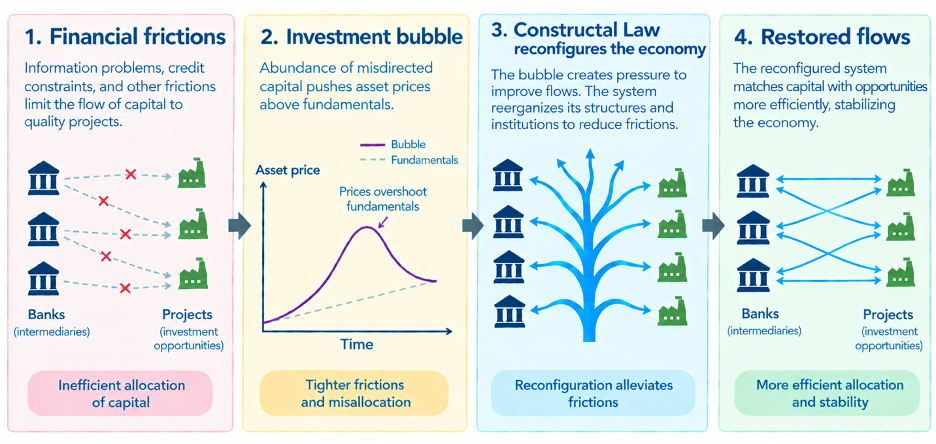
We wanted to share the gist of our first proof-of-concept paper. Our model is inspired by the model of Gertler and Karadi (2011) as presented in Christiano and Ikeda (2013). The original model has a simple chain of monetary flows: depositors « mutual funds « banks « firms. The bankers face a frictional moral hazard of potentially spending subpar effort at finding quality investments, resulting in a lower rate of return to depositors. Because depositors cannot freely observe bankers’ behaviors, the risk of fiduciary shirking gets baked into the contract between the two parties, with the upshot being that bankers lose their residual claimancy to the investments. This, in turn, can induce them to spend less effort searching for good investments, which can trigger a financial downturn. The economic narrative underlying our model preserves much of the framework but shifts the friction source from the effort of the bankers to the supply of good investment opportunities, which are generally outnumbered by the population of bankers. Whereas in the traditional macroeconomic literature, a financial friction is simply a source of market inefficiency, in our Constructal model, it impels the financial system to reconfigure itself in order to maintain investment flow.
Conclusion
In a traditional interpretation of financial economics, crises are market failures that arise from frictions, which ideally get greased with patchwork policy to prevent their recurrence. In an evolutionary Constructal interpretation, such frictions serve as impetuses for market adaptations. Although they may be mitigated in the medium-run through policy, long-run evolvability is generally maximized by allowing markets more evolutionary degrees of freedom, which may get inadvertently curtailed by policy. Thus, in the Constructal interpretation, policy should be directed more at smoothing reconfiguration processes than at reducing the frictions themselves. As we continue to build this Constructal school of economic thought, a key idea to consider is whether the Constructal Law is not merely analogous to finance but constitutive of it. Capital conservation in structured finance echoes the First Law of Thermodynamics. Risk management and regulatory oversight echo the Second Law’s imposition of order on a system tending toward disorder. The evolution of financial institutions echoes the hierarchical, Constructal architecture that mature flow networks tend toward. Taken individually, each parallel is suggestive. Taken together, they invite the claim that financial structure is not merely describable in the language of flow physics but generated by it.
In Closing
We look forward to uncovering the unifying principles of Constructal Law and Finance — continuing to explore the connections that deepen our understanding and help us harness knowledge to advance economics and finance. Let the journey begin…
About the Authors
Michael Stockman is a Managing Partner at WMD Capital Partners, LLC, a real estate private equity partnership, and has been with the firm since 2015. Michael brings over 30 years of experience from senior roles in mortgage trading, global fixed income, capital markets, and risk management at leading institutions, primarily Goldman Sachs and UBS Investment Bank. Mr. Stockman has also been actively engaged in academia and service through leadership and advisory board roles at the Tuck School of Business at Dartmouth College and the University of Colorado. He holds an MBA from Dartmouth’s Tuck School of Business, a Master’s Degree in Mechanical Engineering from the University of Colorado, Boulder, and a Bachelor’s Degree in Mechanical Engineering from Union College, Schenectady, NY.
Albert Magnell
Albert Magnell is an evolutionary theorist working at the intersection of the life sciences and economics. He holds an M.Biochem. from the University of Oxford, an S.M. in biology from the Massachusetts Institute of Technology, an M.A. in economics from Duke University, and an M.Phil. in economics from the University of Oxford.
[1] Bejan, Adrian, and Sylvie Lorente. Design with constructal theory. Hoboken, NJ, USA: John Wiley & Sons, 2008.
[2] Ibid.
[3] Ibid.
[4] Bejan, Adrian, and J. Peder Zane. Design in nature: How the Constructal Law governs evolution in biology, physics, technology, and social organizations. Anchor, 2013.
[5] Baciu, Dan C., Lily Wolf, Marcelo R. Errera, Vinicius Braz de Oliveira, and Umit Gunes. “Constructal thinking: Geospatial and temporal focal points of activity.” BioSystems (2026): 105784.
[6] Bejan, Adrian. Time and beauty: Why time flies and beauty never dies. World Scientific, 2022.
[7] Reinhart, Carmen M., and Kenneth S. Rogoff. This time is different: Eight centuries of financial folly. Princeton University Press, 2009.
[8] Friedman, Milton, and Anna Jacobson Schwartz. A monetary history of the United States, 1867-1960. Princeton University Press, 2008.
[9] Piketty, Thomas. Capital in the twenty-first century. Harvard University Press, 2014.
[10] Fujita, Masahisa, Paul Krugman, and Anthony J. Venables. The spatial economy: Cities, regions, and international trade. The MIT press, 1999.
[11] West, Geoffrey. Scale: The universal laws of life, growth, and death in organisms, cities, and companies. Penguin, 2018.
[12] Bejan, Adrian. The physics of life: the evolution of everything. Macmillan, 2016.
[13] Savitt, Samuel A., and Susan S. Savitt. “Constructal evolution of the Jewish diaspora” in Proceedings of the 15th Constructal Law Conference (2025).
[14] Gunes, Umit. “Analyzing research output: A data-driven approach” in Proceedings of the 15th Constructal Law Conference (2025).