


Battery technology is evolving rapidly, yet thermal management remains one of its oldest challenges. Cells age, packs become larger, and cooling systems consume increasing amounts of energy. The question is no longer simply how to remove heat, but how to provide easier access to cooling where and when it is needed.
Ultimately, batteries are thermodynamic devices. Materials science determines what reactions are possible, and electrochemistry describes how charge is transported and stored, but neither explains how much useful work is destroyed in the process, nor how much additional work should be spent to preserve it. Every watt dissipated, every temperature gradient, every pressure drop and every side reaction contributes to the degradation of exergy—the capacity of the battery to perform useful work. For this reason, battery management is fundamentally a thermodynamic problem: one of distributing limited cooling resources in a way that minimizes irreversibility over the lifetime of the system.
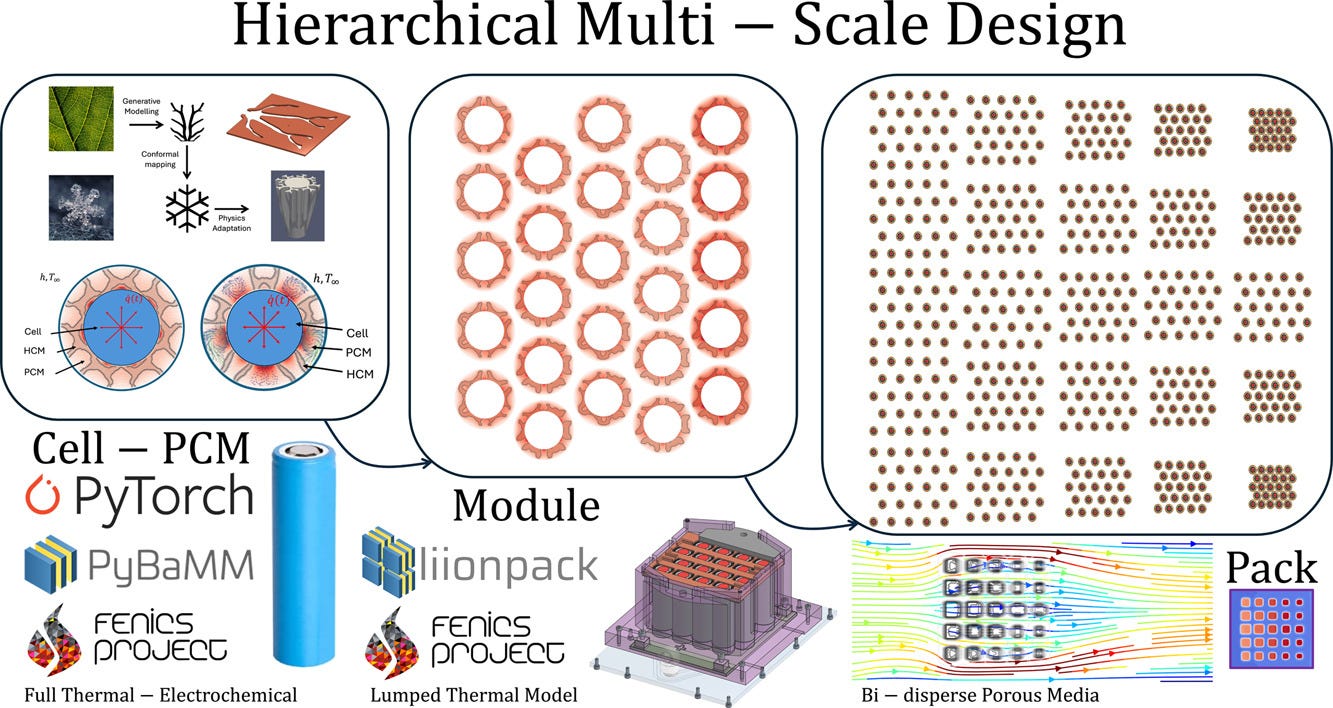
The first paper (Ignuta-Ciuncanu, Marinescu & Martinez-Botas), published in the International Journal of Heat and Mass Transfer, introduces a hierarchical generative design framework for battery packs using phase change materials. Cooling architectures are allowed to morph freely across scales: from high-conductivity inserts surrounding individual cells, to functionally graded module assemblies, and finally to battery pack layouts treated as evolving porous media. The resulting designs reduce hotspot temperatures by up to 60% while requiring only a fraction of the pumping power demanded by uniform configurations.
In my second paper (Ignuta-Ciuncanu), recently published in International Communications in Heat and Mass Transfer, I answer a different question: how much cooling should a battery receive? Using entropy generation minimization, I show that neither fixed cooling rates nor fixed battery temperatures are thermodynamically optimal. Instead, the cooling effort should evolve together with the battery itself. As cells age, they require progressively greater access to the cooling stream, in agreement with the Constructal Law.
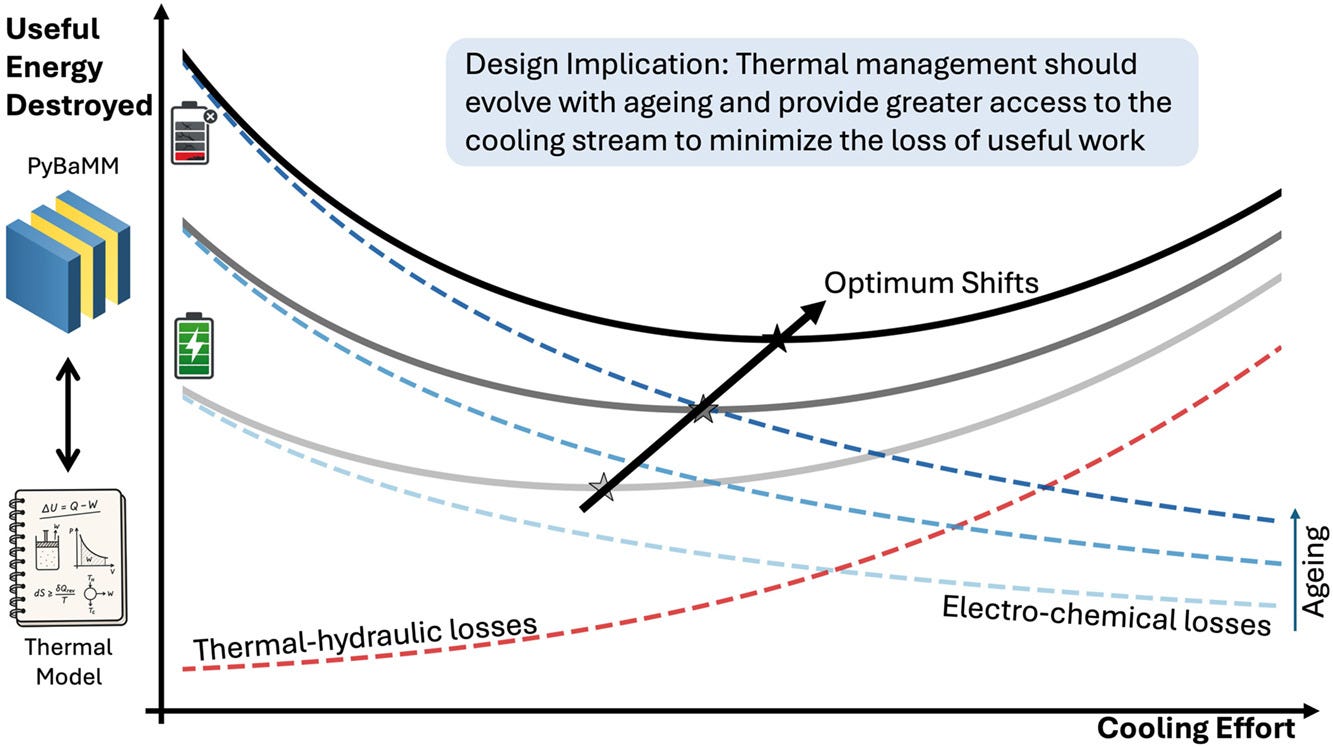
Together, these studies suggest a new direction for battery thermal management. The first addresses the evolution of form—how cooling structures should be configured in space. The second addresses the evolution of rhythm—how cooling intensity should evolve in time.
One changes geometry. The other changes control.
Both point toward the same conclusion: that freedom to morph is freedom to cool (wisely) and persist in time.
Perhaps this is how the next generation of battery thermal management systems will be designed: not as fixed objects, but as architectures free to change, guided by physics and informed by computation. In one word: construcally.