


In the 1990s, IBM engaged with a professor of engineering and applied physics at Duke University to help solve a problem. Increasing microprocessor processing power led to greater heat generation, which had to be dissipated to prevent overheating damage. Professor Adrian Bejan’s designs for having heat flow away from chips inspired his discovery of the constructal law. In designing dendritic (i.e., tree-like) flow structures, Bejan was inspired when he realized he was not imitating nature but predicting it.
As Bejan recently said, “Design takes a long time to do, and then you have to go to the prototype and then to manufacturing. That costs money and takes time. But the idea takes zero money and zero time.” Good ideas are good for business, and ideas informed by science and the laws of nature are better than those that are not.
Bejan not only predicted the optimal design for heat flow in the 1990s laptop computer; his prediction still holds in the evolution of AI datacenter cooling. The constructal law that Bejan discovered also applies not only to heat flow but to everything that flows in spacetime, both animate and inanimate, as well as to material and immaterial (e.g., ideas, knowledge, wealth, culture).
Because the constructal law applies universally and can be observed at all scales, it also applies to businesses, supply chains, and distribution networks. As such, my objective is to focus on the commercial applications and implications of the constructal law, and to consider their implications for business leaders.
This article is intended to introduce these insights to an audience that doesn’t have much time for or interest in new science but rather values practical insights into industry, market dynamics, and competitive advantage. Why? Because the constructal law explains many of these business and market dynamics in a manner grounded in physics. As such, our ability to understand, predict, measure, and optimize key performance indicators in commerce and industry is significantly advanced by the scientific knowledge of the constructal law and its associated theory.
Primer on the Constructal Law
In 2018, Bejan was awarded the prestigious Franklin Medal for his discovery of the constructal law and for introducing constructal theory. As a Franklin Medalist, Bejan has joined the ranks of science luminaries such as Albert Einstein, Max Planck, Niels Bohr, John Archibald Wheeler, and Stephen Hawking. Yet at the time of writing this in 2026, the constructal law and constructal theory remain obscure, and the chance is high that you’re reading about it here for the first time.
Latency refers to the time and course required for ideas to spread and be adopted. William Gibson famously said, “The future is already here – it’s just not very evenly distributed.” The same could be said for knowledge of the constructal law and the insights and implications it yields. Bejan’s discovery of the constructal law offers powerful, practical insights that needn’t wait for mainstream awareness. The knowledge exists and needs only to be applied and further studied.
The constructal law is not yet a familiar household term, but it should be. It should replace any use of more familiar terms, such as fractals, complexity, and chaos, none of which have any foundation in physics, and all of which can be better explained by the constructal law, whose foundation is in physics.
As explained by Prof. Adrian Bejan, who discovered the constructal law in 1996, “Everything that moves, whether animate or inanimate, is a flow system. All flow systems generate shape and structure over time to facilitate this movement across a landscape filled with resistance … The designs we see in nature are not the results of chance. They emerge naturally, spontaneously, because they enhance access to flow in time.” (Bejan, A.and Zane, J.P., Design in Nature, 2012) In other words, the constructal law, as a law of physics, explains how nature designs itself. In nature, one can observe evidence of the constructal law in patterns seen virtually everywhere.
2. As a primer on the meaning and implications of constructal law and theory, the following figure illustrates some of the core concepts of constructal dynamics. More than just ideas, each of the phenomena illustrated below is representative of empirical observations of reality and an abstraction of a deeper universal truth, i.e., the constructal law.
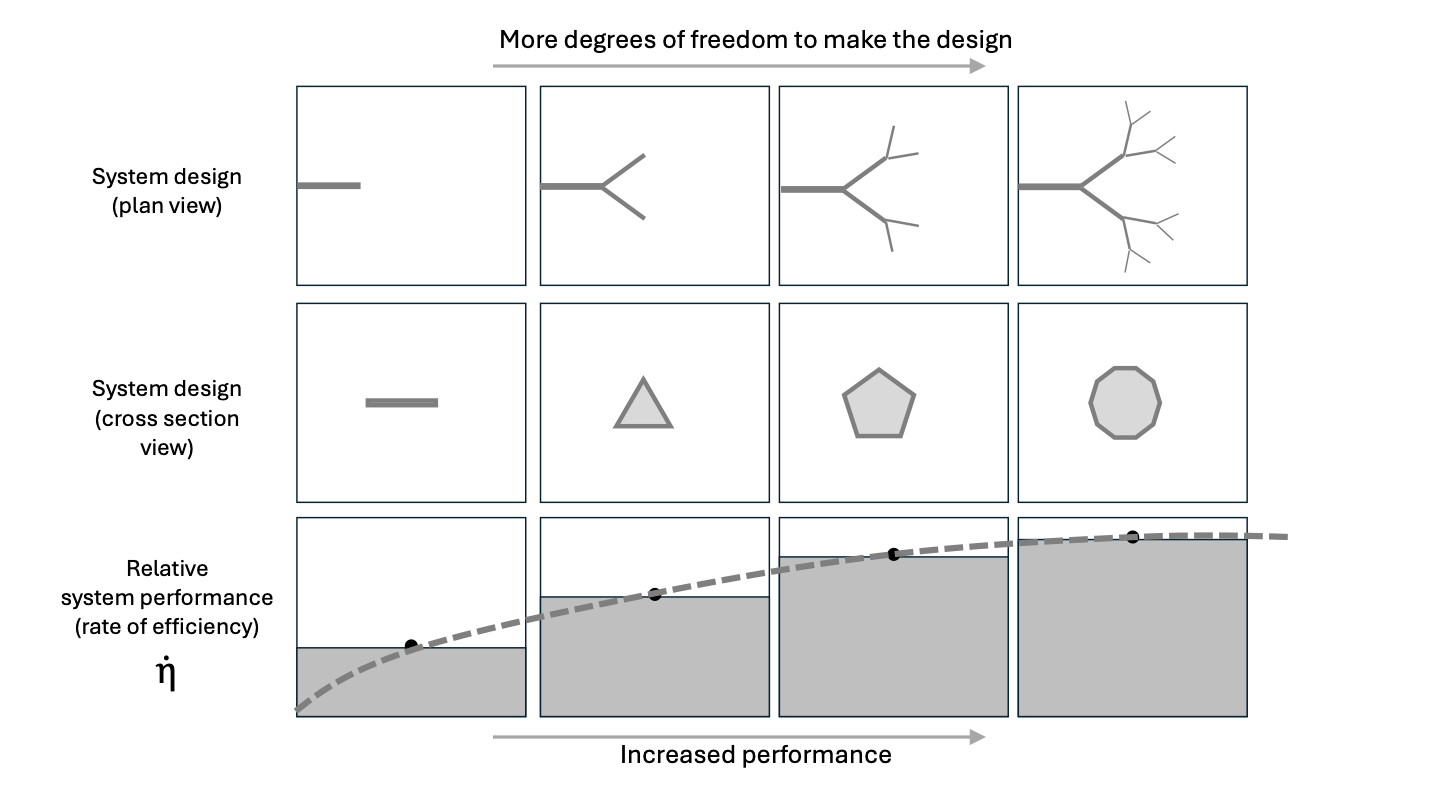
In Figure 1 above, two examples illustrate emergent structure and form in nature that evolve directionally and purposefully toward greater detail and refinement. This phenomenon demonstrates diversity and hierarchy in the spontaneous evolution of the system, aimed at increasing flow access. The first row shows a plan view of a branching, tree-like flow system that flows from a point on the left to the area on the right. The second row shows a polygonal cross-section view that transitions to a circular cross-section, as seen, e.g., in veins and vascular channels. The constructal law explains why systems in nature do so: to enhance access to flow.
Enhanced access to flow, or flow efficiency, is shown in the bottom row, where the relative system performance is determined by the flow system's efficiency rate (η̇). Performance increases monotonically in the direction of the system’s evolution. All points of this space are either above or below the curve. The curve illustrates the boundary between the impossible above the curve and the possible below. What is this space above the curve? Why is it impossible? The answer lies in the 2nd law of thermodynamics, which defines a system's perfection as having zero energy loss and establishes that such perfection cannot be achieved by design. Impossibility here is directly related to and required by the 2nd law of thermodynamics. It cannot be avoided or eliminated, but can be reduced and minimized.
Why the Constructal Law Matters
James Watt did not invent the steam engine, but he more than doubled its efficiency at the time, thereby changing the industry and the world forever, effectively displacing slavery as a source of power for work. He was able to do so by understanding thermodynamics. The laws of thermodynamics are now known to apply universally, not only to steam engines but to all aspects of industry, commerce, and social organization.
Business leaders are already familiar with the concepts of throughput, distribution, performance curves, and performance improvement through innovation. The constructal law not only explains but governs how all these, in fact, all systems, evolve over time. It suggests that flow system efficiency is the principal driver of performance and that this efficiency arises from the flow system's shape within its environment. In both nature and industry (which is part of nature), flow systems, given the freedom to do so, will evolve with emergent structure to flow more efficiently.
On one level, this continuous drive for improvement will happen regardless. In the industry, this improvement is forced by competition and customer demand. For businesses to survive, they must grow and continuously innovate; otherwise, they risk going out of business. All of that still applies and accelerates. So, how does knowing the physics behind the throughput of flow systems help? It helps because science allows one to make predictions with confidence. When designing new products or services, being able to predict outcomes, minimize trial and error, reduce risks, and accelerate growth helps.
Considerations for Business Leaders
Many of the concepts described above are familiar. The only new news is that science has advanced to the point where it can offer a greater understanding of the concepts essential to business. My main recommendation is to encourage curiosity to learn more about science and how it can be applied to specific business challenges. For now, I list below a few of the ways in which I apply my knowledge of the constructal law with regard to how I approach my own work in business:
Optimizing flow systems
Know your priority flow systems and benchmark their performance. Note that everything in nature, as well as in business and the universe, is a flow system.
Whether the supply chain, assembly line, distribution, or sales, each is a flow system whose efficiency can be measured and optimized. However, other important flows also exist, such as people, culture, knowledge, and information. I work in IT Services, where the flow of knowledge and information is arguably the lifeblood of a modern IT services business. Understanding the science of flow systems can help optimize those most important aspects.
Reducing and eliminating bottlenecks
The importance of managing and mitigating bottlenecks has long been recognized in widget manufacturing. This had been essential for the industrial economy but has become even more so in the information economy. Information flows are harder to see than the path of a widget on an assembly line. Working in IT services, I am sometimes painfully aware of information bottlenecks. We know where the bar is for information to travel from one place to another: the speed of light. When your firm has information in one place that has value somewhere else, you have an information bottleneck if it is not getting there at the speed of light.
Knowing and exploiting degrees of freedom
Evolution and improvement can only happen when freedom exists. Sometimes you want guardrails, so there are limits placed on freedom to change. At other times, limiting the freedom to change has the unintended effect of preventing improvement. Businesses are now wrestling with AI, including which tools employees can or cannot use and what they can or cannot do with them. Making these decisions should be done with awareness of the degrees of freedom employees have to innovate.
If you’ve read this far, you may already have an advantage over business leaders who are unaware of constructal science. If you’d like to be more informed and engaged with a growing community of scientists, scholars, and business leaders, let me suggest the following:
Read and Follow the Work of Professor Adrian Bejan
Bejan has written many books and scholarly articles. Of all of these, I recommend business leaders start with Bejan’s book: Freedom and Evolution: Hierarchy in Nature, Society and Science, published by Springer Nature in 2020Engage in an active international community of scientists, scholars, and business leaders
who are advancing Bejan’s work in terms of both application and theory. The leading edge of this can be found in the program and proceedings of the annual Constructal Law Conference.
See the latest here: Proceedings of the 15th Constructal Law Conference (CLC2025)
The next conference will be in Paris, Oct. 2026: 16th Constructal Law Conference (CLC2026)Stay up to date and informed
Follow/Subscribe to the Constructal Law Newsletter at constructallaw.com
About the Author: John Mullaly
John Mullaly is a creative technologist whose career spans more than three decades at IBM and now Kyndryl, the 2021 spinout of IBM’s global services business. His work is at the intersection of emerging technology, design, strategy, and new business ventures. An IBM Master Inventor (emeritus), he has been issued more than forty patents in human–computer interaction. His work in technology has progressed from computer graphics and software design to building first-of-a-kind cloud and data analytics services. As a senior advisor in IBM Corporate Development, he interfaced with startups and venture capital firms and advised IBM leadership on more than forty acquisitions. He co-authored a book on user-centered software design and received the IBM Chairman’s Corporate Patent Award for his pioneering work in three-dimensional interactive environments. His education spans art, mathematics, and computer science (BS in General Studies, New York Institute of Technology) and business (MS in Technology Commercialization, University of Texas at Austin). Alongside his technical career, Mullaly is an active artist in painting, sculpture, and creative writing. He resides in the Hudson Valley in upstate New York.
I enjoy putting together Umit Gunes on the Constructal Law, and I’m glad to share it with you for free. I hope you find it engaging and worthwhile. Preparing each post takes considerable time and effort, so if you appreciate Umit Gunes on the Constructal Law‘s content and can support it, please consider choosing one of the paid subscription options.
How might Constructal Law inform new designs for governance? Governance can be considered to be bidirectional flows of information and energy. Governance is not business, however much corporations want to make it so. From the perspective of Constructal Law, how would governance and business be differentiated?